If you have ever roamed the landscapes of Second Life and found yourself transported into a world so vivid you could almost feel the sun on your skin or catch the scent of pine drifting through the breeze, you may have stepped into the world of Steelhead Outfitters. Renowned for immersive environments and lifelike interactive experiences, Steelhead has earned a reputation for exceptional craftsmanship, quality, and imagination across the grid.
At the heart of Steelhead is Chelsea Malibu, a visionary creator driven by a love for exploration, realism, and storytelling. Her portfolio ranges from rugged outdoor adventure gear and fully interactive Ranger Carts to intricately designed Western towns and event-ready stages. Each piece reflects her commitment to detail, authenticity, and the playful spirit that keeps Second Life thriving with creativity.
Chelsea’s work has become a staple for residents who value environments that feel genuinely lived-in and emotionally engaging. Whether she is crafting a peaceful campsite, developing beloved scuba gear, or building a festival space ready for live entertainment, she infuses every project with personality, humor, and heart. Her ability to balance realism with whimsy has made Steelhead Outfitters one of the most distinctive and respected brands in virtual design.
In this exclusive interview, we explore the inspiration behind Steelhead, the creative journey that shaped its vision, and the passion that fuels the artistry behind one of Second Life’s standout creators.

The Interview:
Q. Can you tell us a little about yourself and how your creative journey in Second Life began? We’d love to know what first drew you to building and creating in this virtual world, and how that early curiosity evolved into the full-fledged brand and creative vision we see today.
A. Chelsea: I saw a cover article in The New Economist when I was coming home from a conference. It was about this new world with a digital economy, and I was intrigued since I worked for a large online payment provider at the time. After I got home and settled in, I logged in. I don’t think I logged out for three days!
Q. Grant: How long have you been doing it? Was it a natural extension of your personal interests, or something that grew over time as you explored different aspects of SL creation?
A. Chelsea: I literally started creating my first day here. It was pretty much all I was interested in. I used the textures that came in the library, threw them on prims, and made stuff. Back then there were no free accounts and everyone got some land, so I’d sit there and build. Then I decided to buy a sim and built it out. Stroker Serpentine came by, saw what I was doing, and pretty much hired me on the spot to build sims for him. Within six months of joining, I was building professionally. Then I was hired by Playboy and Jenna Jameson to create a region of nine sims for them. That was during the corporate heyday of SL. When the corporations left, I took some of my things and opened a store, mostly lighting pieces and some clocks.
Grant: I also want to point out to our readers that Chelsea is celebrating 19 years in Second Life. That kind of longevity and dedication shows in every build and project she touches. It is remarkable to see someone still pushing boundaries and creating with the same passion nearly two decades later.

Q. Grant: Is there a story behind the name “Steelhead” that you’d like to share with our readers? Many creators have a special meaning or inspiration tied to their brand name whether it’s personal, symbolic, or simply a reflection of the kind of energy they bring to their work.
A. Chelsea: It was Malibu Lighting and Design at first, but when I started doing clothing, I wanted my designs to feel more like L.L. Bean or Bass Pro Shops. I was going for an outdoor name, and when brainstorming with a real-life friend, we came up with the name Steelhead since I’m an avid fly-fisher.

Q. Grant: Have you always been drawn to outdoor and adventure-themed builds, or did that passion develop gradually as you explored new creative directions?
A. Chelsea: I love the outdoors. It has been that way my whole life. I’ve been a white-water guide, an avid skier, hiker, backpacker, mountain biker, and just about everything in between. My sister and I were very much tomboys.
Grant: Hearing that makes so much sense. Your real-life love for the outdoors clearly translates into what you create in-world. There is an authenticity in your builds that feels lived-in instead of imagined, and I think that comes from having actually been out on the trails, on the water, and in those environments. It gives your work a depth that residents really respond to.
Chelsea, I am a big fan of Western themes in gaming, especially Red Dead Redemption, so when I first saw your builds, I was blown away. The level of detail and atmosphere you captured felt like stepping straight into that world.
Q. Grant: The 1883 Town and Railroad Station builds are incredibly detailed and full of character. What inspired you to take on that vintage Western theme, and how did you approach capturing that old-world charm while still making the experience interactive and immersive for residents today?
A. Chelsea: I do this in real life for a game company as well. I made a saloon I needed for a Scottsdale, Arizona scene and then decided to bring it into Second Life. It seemed like most Western builds in SL looked old and worn out, but if you were in a Western town in 1883, it would not have looked old and worn out back then. People wanted me to make more, so I did.
I try to make the 1883 town as authentic as I can. I did a lot of research. The schoolhouse is still standing in real life, in a state park in California: Calico Ghost Town. The flag on my schoolhouse has 36 stars, and the map on the board is from 1883. There is also a portrait of President Chester Arthur, who was president in 1883. Every little detail is from 1883 or earlier.

A walk through Steelhead’s frontier town feels like crossing a line between Second Life and history 1883

Where chalk met frontier dust: inside the 1883 schoolhouse – A glimpse inside the 1883 schoolhouse.

Grant: I also need to mention your 1883 railway and train. The craftsmanship there is next level. The station, the rail lines, the train cars, all of it feels like it rolled right out of history. You did not just place a train in a scene, you built an atmosphere around it. When you stand on that platform, you feel like you are waiting on the next steam engine to pull in. That level of detail is what makes your work so memorable in Second Life.

Q. Grant: Are there any new builds, collections, or projects currently in the works that you’re particularly excited about? Maybe a sneak peek into something upcoming that showcases the next evolution of Steelhead’s creativity or expands on what your customers already love.
A. Chelsea: I’ve been doing whole-scene builds lately, bigger projects that are full, comprehensive environments… kind of a “party in a box,” lol. At the Uber Event right now is my biergarten, and on my staging platform at my shop is my new Mexican town.

Grant: I’ve seen both of those builds, and they’re incredible. Your biergarten already has such a lively feel to it, but that Mexican town really caught my eye. The cantina especially has so much charm and atmosphere. It feels like the kind of place you could wander into, grab a drink, and stay way longer than planned. You bring life into these spaces in a way that makes people want to hang out, not just look.

Q. Grant: Every creator has that one project that stands out either for the challenges it presented or the satisfaction it brought when completed. Which build or product line has been the most challenging or rewarding for you personally, and why does it hold such a special place in your creative journey?
A. Chelsea: That’s always my latest creation, lol, but golf has been both a challenge and a delight. We are soon adding mini golf and a new croquet system. The mini golf is open for beta testing now if anyone wants to try it.
Q. Grant: Since you brought it up, Can we talk a little bit about the TrueGolf system?. It has really made waves across the grid. I’ve watched people who never played golf in SL fall in love with it because of how smooth and intuitive it feels. You took a sport that can be tricky to translate into virtual space and made it something people actually want to spend time doing. Seeing players get competitive, bring friends, or just enjoy the course like they would in real life says a lot about how thoughtfully it was designed.
A. Chelsea: Well, I tried the old golf system from Elite. I thought it was okay, but it seemed like so much else in Second Life… it was a workaround and not very realistic. I knew it could be better. I hired a studio to make the mocap animations, made the mesh, and then needed a scripter. I went through three scripters; all of them said what I wanted could not be done. Then came Poppy. She said she was working on a golf system, and our late friend Lexy Amore introduced us. Poppy is the most amazing scripter I have seen in Second Life. Like me, she also does this in real life, and she has her master’s in computer programming. She never says anything can’t be done. It is always, “Let me figure out how we can make this work.” We are both RL golfers so we know how it should work. It’s been our goal and the reason for the name.

Q. Grant: When you look back at where you started versus where you are today, how do you feel your building style or overall creative vision has evolved? Have there been key moments, lessons, or breakthroughs that shaped the way you approach design now compared to when you first began?
A. Chelsea: Well, I think it’s been more the evolution of what SL has created for us to work with. I try to keep up with the latest and learn how to best implement it. I’ve been using PBR for my RL work for 8 years, and when they said SL was going to have it, I jumped right in. For any up-and-coming artist, I have this one bit of advice I got from one of my art instructors in college: look at stuff the real-life stuff. See the imperfections, see the shadows, the dirt, the wear. Look at these closely and incorporate that into your art and creations
Grant: That is such grounded advice, and it shows in your work. Paying attention to real-world detail instead of just chasing perfection really separates true creators from copy-and-paste builders. I appreciate how you tied technique back to observation and patience. It reminds people that great art in Second Life still comes from the same fundamentals as great art anywhere else. Thanks for sharing that insight.
Alright, moving into the final question.
Q. Grant: Your creations often strike a perfect balance between realism and functionality from the drivable Ranger Carts to the animated scuba gear. How do you achieve that harmony between beautiful design and smooth usability, ensuring that your builds not only look amazing but perform well in Second Life’s unique environment?
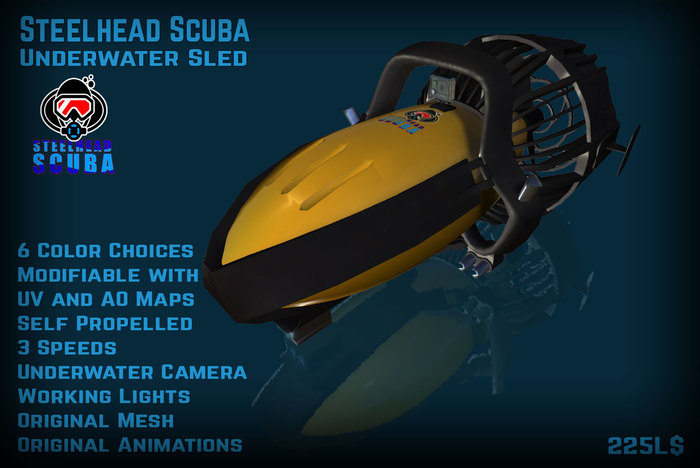
A. Chelsea: LOL, that is soooooooooo not easy. SL has so many glitches. The scuba gear is a good example. How do you make a PFD that will fit everyone? So I cut the shoulder straps way off to the side. It still looks real, but it will work with any chest size, male or female. Most of it is just trial and error, and often you have to go outside your idea of real to make what I call ‘SL real’, real, but with limits so it actually works here.
I made the scuba gear because my boat crashed on the Blake Sea. Then I was in the amazing underwater area and was like, WTF? This is what’s under the water? So I said, I’m getting some scuba gear and exploring. Everything I found was crap, so I made my own.

Grant: That’s amazing! You run into a limitation, you look around for a solution, and when nothing meets the standard, you build it yourself. The scuba gear is a perfect example of that mindset. Instead of settling, you turned a problem into an opportunity and ended up giving the community something far better than what was out there. That kind of curiosity and drive to explore and improve is exactly what keeps Second Life evolving.
In Closing:
Grant: Chelsea is there anything more you would like to say or add for our readers?
Chelsea: Nothing special, other than one bit of advice: meet noobs and help them. Show them how Second Life works and, of course, take them to my store, lol. Philip Linden told me a while back that the biggest problem newcomers have is the confusion. Take someone golfing, scuba diving, or whatever, and you will change their Second Life. That is our primary goal, to make Second Life more fun.
Grant: Thank you for sharing that. Chelsea, Thank you! It has truly been a pleasure sitting down with you for this one-on-one. I’ve loved getting to know you and watching how you continue to add to Second Life. I appreciate you and everything you contribute to this community!
Talking with Chelsea and learning about the creativity behind Steelhead Outfitters was a reminder of what makes Second Life so special passionate people bringing their imaginations to life and sharing them with the world. From the smallest details in an outdoor scene to the thrill of a playable golf course, everything she creates is built with heart, humor, and craftsmanship.
If you haven’t already, make sure to visit Steelhead Outfitters in-world to experience the magic yourself, whether you’re setting up a festival, exploring the 1883 Town, or diving deep with the best scuba gear around.
Steelhead Outfitters – In-World Store
Steelhead Outfitters Marketplace: https://marketplace.secondlife.com/en-US/stores/6057
Until next time – keep exploring, keep creating, and as always, throw kindness like confetti. -Grant Wade