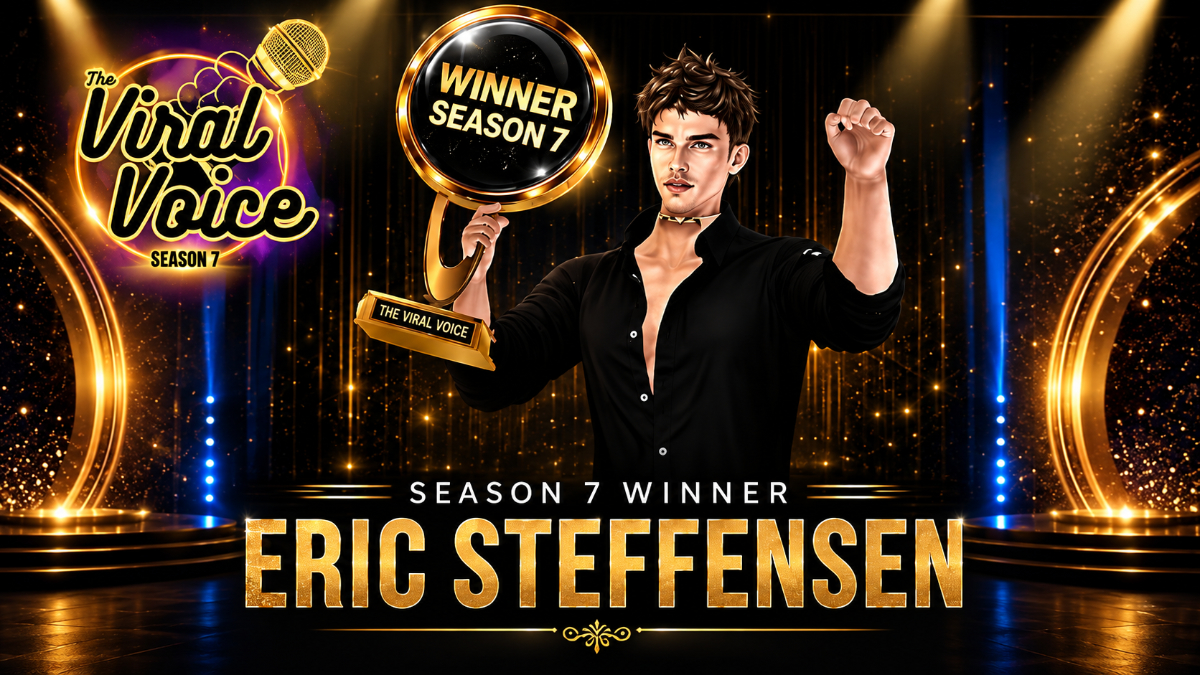
The Story Behind The Viral Voice Season 7 Winner
From 17 Years in Second Life to the Top of The Viral Voice
There are a lot of ways to measure success in Second Life.
For some, it’s the size of their audience. For others, it’s the venues they perform at, the recognition they receive, the friends they make, or simply the feeling that they’ve created something meaningful.
For Eric Steffensen, winning Season 7 of The Viral Voice seems to encompass all of those things—but listening to Eric talk about the experience, the trophy itself may not even be the most important part of the story.
What stands out is everything that happened on the way there.
Seventeen years after coming to Second Life because of its live music scene, Eric found himself taking on a competition that pushed him far beyond simply singing on a virtual stage. He built stages, scripted performances, worked with dancers, promoted himself, recruited supporters, learned new skills and, perhaps most importantly, challenged himself to go all in.
I wanted to sit down with Eric after his Season 7 victory and let him tell that story in his own words.
So rather than putting together a conventional winner’s profile, I wanted this to be a conversation about the person behind the performer—the music, the competition, the challenges, the people who helped him along the way, and what winning The Viral Voice ultimately means to him.
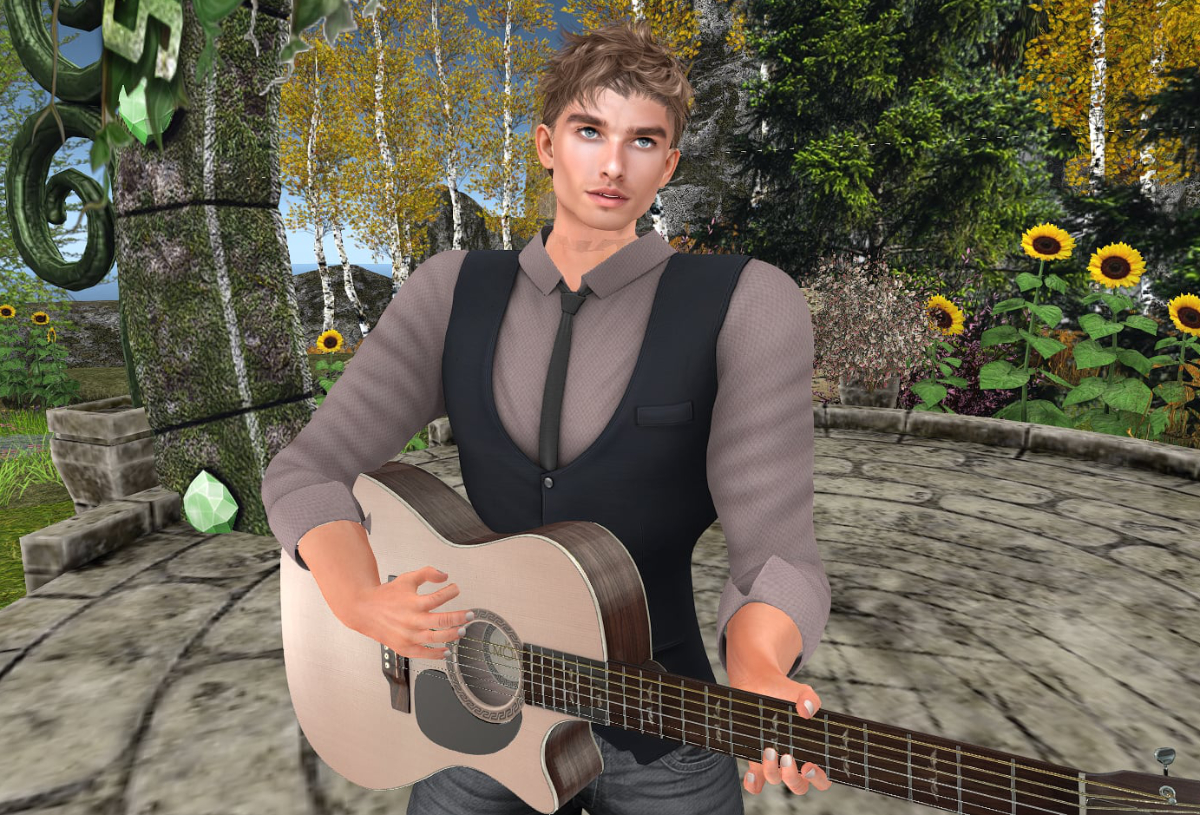
The Person Behind the Avatar
For those who may not know you well, tell us a little about yourself in Second Life. Who is the person behind your avatar?
Well I joined Second Life 17 years ago because I read an article about the live music scene and I wanted to perform more. So I came for the music… But for me the relationships I’ve built over the years have become just as important as the music. In RL, I wear a lot of hats. I’m a dad, a sales rep for a software company, a boyfriend, a songwriter and a guy who enjoys his whiskey, college football (GO UTES) and Star Trek.
That feels like a pretty good place to start.
The story of Eric Steffensen isn’t simply about discovering Second Life as a place to perform. It’s also about the relationships that grew around that music—and those relationships would eventually become a major part of his Viral Voice journey.
When did you first discover your love of singing?
My whole family sings. We grew up singing around the piano (my mom plays) so even today we sing Happy Birthday in 4 part harmony. I remember winning the part of Winthrop in a community/church production of the Music Man when I was 8…and I loved doing that. That led to me wanting to learn an instrument, which eventually became the Tuba in Jr. High and High School, as well as the piano because my grandma taught piano lessons.
There’s something fitting about that story. Music wasn’t something Eric simply picked up later in life—it was part of his family and his childhood from the beginning.
And eventually, that early connection to music would lead him to a virtual world where he could continue developing it.
Finding The Viral Voice
What inspired you to enter The Viral Voice?
I kept hearing about people who had competed (and a couple who had won) so I had been interested in participating since around the end of Season 6. But I didn’t know how to get involved or who to reach out to, so I’m grateful that Abby Alexander reached out to me and asked me to apply. From there, I found out that both Grace Loudon and Winter were former winners and I already admired both of them for their performing style and musicianship, and that was a club I would love to see myself in, so at that point I was sold (still without really knowing what I was getting into).
Sometimes the biggest opportunities begin with simply saying yes before you completely understand what you’ve signed up for.
Eric’s interest had been building since Season 6, but it took Abby Alexander reaching out to him to turn that interest into an application.
Before the competition began, did you ever imagine yourself actually winning?
On some level I did, but I think I spent more time telling myself that if I made it 4 or 5 episodes in that I would consider it a success. The other thing I kept telling myself…if I’m able to book one new venue, or get a few new fans that are repeat visitors to my shows, then it would be worth it. That had already happened around episode 4 or 5 (thanks in part to a conversation you and I had on Facebook)
I have to admit, that last part made me smile.
Going into a competition like The Viral Voice with realistic goals—make it a few episodes, gain some fans, maybe book a venue—and then watching those goals begin happening along the way is a pretty good reminder that success doesn’t always wait until the final announcement.
Sometimes it happens one step at a time.
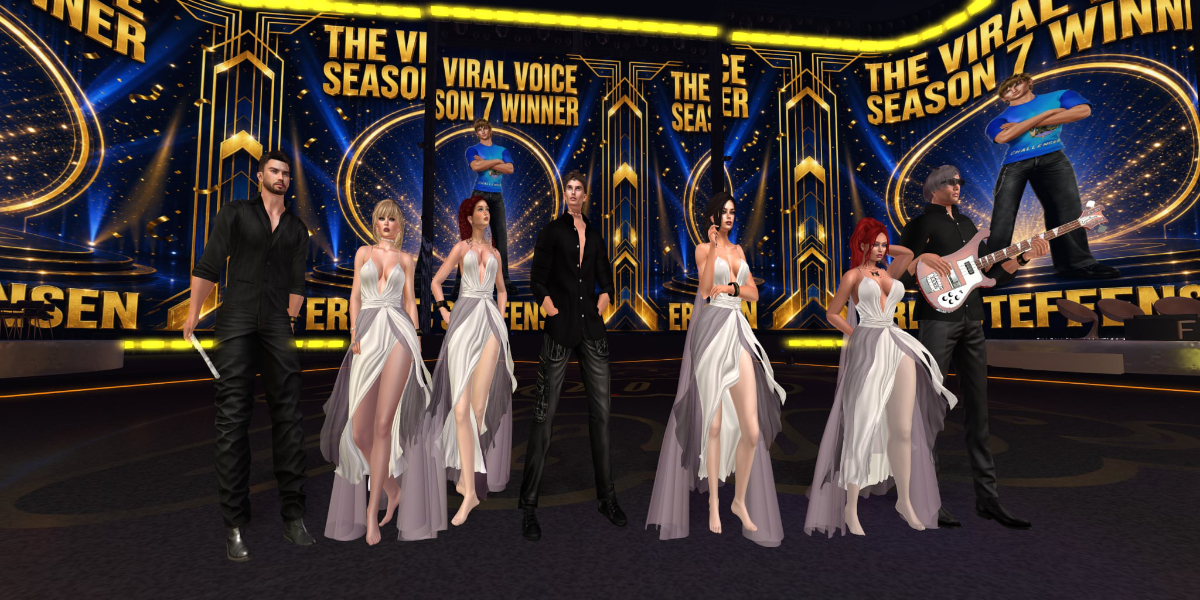
The Competition
What was going through your mind when you heard your name announced as the winner?
Oh wow. I remember thinking “Holy shit! I pulled it off” and then it was like an explosion of intense emotion. And then I was trying to get my avatar to hold up the trophy. But due to either lag or other supernatural causes, my mouse wouldn’t respond at all. I ran into the other room to grab a battery and even that didn’t fix it…when I finally got it working I apparently attached multiple objects at the same time and ended up holding up one of my tip jars from my inventory. So you might say that all this emotion was accompanied by some chaos. But thankfully later that night I got my act together for the after party.
That may be one of the most Second Life victory moments imaginable.
After weeks of rehearsals, performances, voting, building and pressure, Eric finally wins—and then Second Life decides the trophy needs to be replaced by a tip jar.
Fortunately, the trophy eventually made its appearance.
Was there a particular performance during the competition that felt especially important or meaningful to you?
Episode 4 — The Other Me. I sang New York, New York and this was a pivotal performance for me. I had just learned the song, but I really liked how it gave me the space to be especially expressive with my voice.
The theme that week was “The Other Me,” and I connected the song to that version of myself who might have taken a different road and pursued music and performing more seriously. So there was something fun about getting to step into that version of myself for a few minutes and really play the part of the big-stage performer.
It was also around that point in the competition where I started realizing how much more I could do with the performances beyond just standing on stage and singing a song. My only complaint about that performance is that I had technical glitches with SL that kept my avatar from animating. But even with that, it felt like one of the first times in the competition where I started seeing what I might be capable of.
That idea of “The Other Me” seems to have become bigger than just the theme of an episode.
It became a glimpse of what Eric could do when he stopped thinking of himself as simply a musician performing in Second Life and started thinking about the entire performance as an experience.
Which song you performed was your personal favorite, and why?
Fragile, The very last song I performed in the Finale. Really the best way to make a performance personal is by performing a song I’ve written. And this is the one song that if I don’t play it early gets requested in every show I do (sometimes after I’ve already sung it).
There is something special about finishing a competition with a song that you wrote yourself—especially one that has become so closely connected with the people who come to hear you perform.
Was there a moment during the competition when you doubted yourself?
Yes. The very first episode, not only had I not successfully recruited any of my friends or fans to attend in person, but the response from the judges in that episode was lukewarm at best. And I remember feeling anxious about asking people to vote for me on a website. I felt like I had a mountain to climb just to be competitive at that point.
From that first episode to standing there as the winner, that’s quite a mountain indeed.
What was the most challenging part of competing in The Viral Voice?
Managing and prioritizing my time. Between building stages, scripting them, coordinating with my dancers, going out and canvasing for votes, recruiting people to attend in person, performing my shows, trying to build up my social media presence, every day was filled with hours of stuff that needed to get done. I still don’t know how I did it but it just became the most important thing in my life to play full out and give everything I had to show off who I was as a performer.
That answer probably gives people a better understanding of what The Viral Voice actually demands from its contestants.
The performances may be what the audience sees, but behind those performances are hours of preparation, coordination, building, scripting, promotion and problem-solving.
How did you handle the nerves and pressure that came with performing in front of an audience and judges?
This is a tricky one because for an average SL show i rarely ever get nervous anymore. But even stepping on the stage for the first time for rehearsal, I felt nervous. This was before there were judges or an audience. And then in that first performance, my nerves made playing guitar much more difficult and it took a good 10-15 seconds to even play the right chords. So in that moment I just tried to calm myself down and make the rest of the performance as good as I could. By the finale, I still experienced those nerves (usually about 30 seconds before I started) but had made sure to choose songs that weren’t as challenging on guitar so that wouldn’t mess me up. Even still in the finale I remember reaching for a high note that my voice just said “no” and responded with a very dry tone. I actually thought that was going to lose me points with the judges and audience but when I listened back to the recording it wasn’t as bad as I remembered it.
Did the competition change the way you approach performing or singing?
I think I’m much more conscious of the energy I’m projecting when I’m singing than before. Before TVV, I was super aware of the more technical aspects…my pitch, my guitar playing, the balance of sound. But with the Viral Voice I realized that there’s more to it than just the technical musical stuff. There’s the visual aspect (which I developed a ton of new skills around) and the energy you project. And those can be even more important than the technical stuff alone.
And I think that may be one of the biggest takeaways from Eric’s entire experience.
The Viral Voice didn’t just test whether he could sing. It challenged him to think about how the audience experiences a performance.
The Music
How would you describe your musical style?
ADHD. Haha. On one hand, you can say I’m all over the place. On the other you can see how wide of a range I have. Both are true depending on your perspective. But all kidding aside, my roots are rock music from the 80’s and 90’s and I’ve pulled other influences from everywhere including jazz, blues, folk, soul, and classical. When I came to SL I called myself the Acoustic Rocker but I don’t think that’s the best description. At the end of the day I just want to express who I am and not put that in a box. There are a lot of different sides and music gives me the opportunity to explore all that.
That probably explains the wide-ranging setlists people have come to expect from him.
Who are some of the singers or artists who have influenced you?
I spent the last half of the 90’s and early 2000’s being obsessed with Smashing Pumpkins. That happened to be the time I was also learning guitar and songwriting, so their influence is huge. Foo Fighters is another band that I’ve tried to channel in my songwriting. I would also include the Beatles, Eric Clapton, Steely Dan, R.E.M., Queen, John Mayer and Seal in my shortlist. Also when I was starting to write songs, I had a close friend named Gene Deal who was a local singer/songwriter with a folk and blues style that I learned a ton from.
That’s a pretty impressive musical family tree.
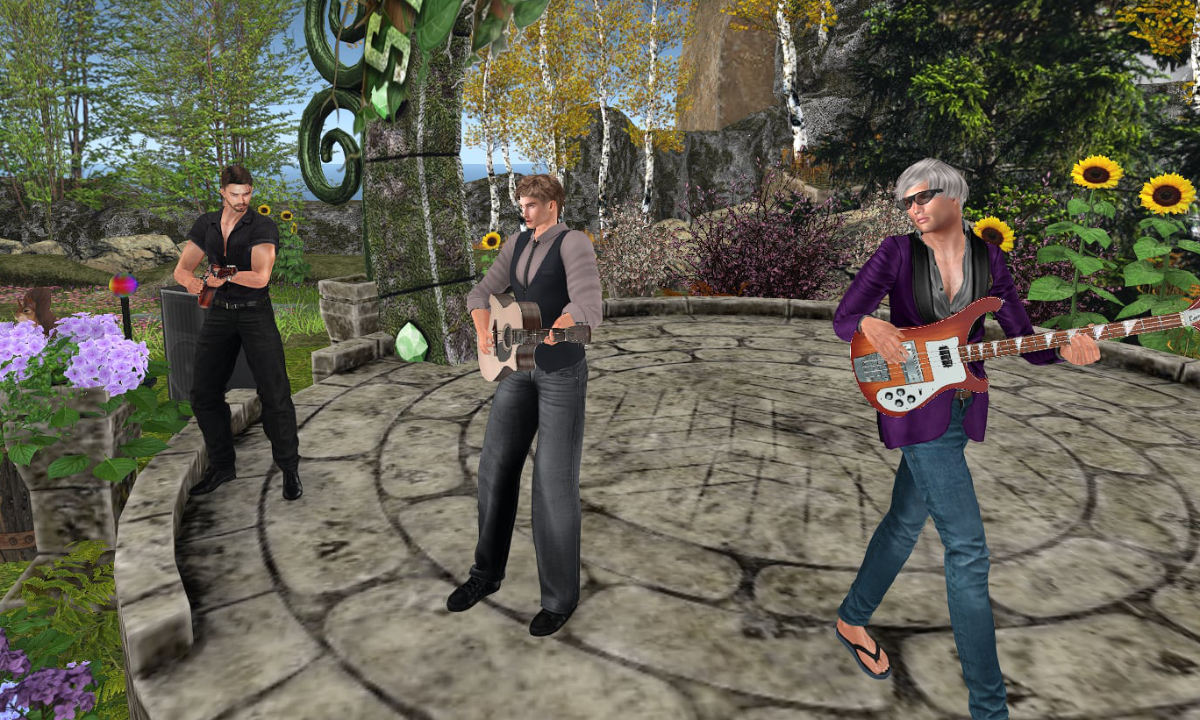
If you could perform a duet with any artist, living or legendary, who would it be?
I only get to choose 1? Hmmm. I think doing some kind of duet with Dave Grohl would be epic.
Also on the shortlist: Lady Gaga, Freddie Mercury, Robert Plant (from the 70’s), Steve Perry, Stevie Nicks, Stevie Wonder, Johnny Cash, Joan Jett, Billy Corgan, Michael Stipe, Daryl Hall, Ray Charles, Sheryl Crow, Eddie Van Halen, Beyonce, Eric Clapton, Bjork, Seal, John Mayer (I could keep going)…well ok maybe it’s not a very short list 😀
Also just want to say that I absolutely treasure the opportunities I’ve had to do duets and jam with so many artists from SL. There are too many names to mention here but we’ve been fortunate over the years to have some really amazing talent
I think we can safely say that narrowing it down to one artist was never going to happen.
And that final thought is important too. For all the famous names on Eric’s musical influence list, some of his most treasured musical experiences have happened right here in Second Life.
Is there a song you have always wanted to perform but haven’t had the opportunity to sing yet?
I haven’t figured out how to translate Bohemian Rhapsody to a solo acoustic performance and really nail it. People have super high expectations for that song, so every so often I’ll keep working on it.
Honestly, I think a successful solo acoustic version of that song would be quite an accomplishment.
What makes a song special enough for you to want to perform it?
This is all about how the song makes me feel when I practice it. If it improves my mood, or makes me excited just from imagining myself performing it, that’s usually a sign that it will make its way into my set.
Then the audience gets a vote. Sometimes I’ll add something that I think is going to work really well and it just doesn’t connect the way I expected. Other songs take on a life of their own. Fragile is probably the best example of that. I obviously have my own connection to it because I wrote it, but over the years the audience has made that song something bigger for me because of the way people respond to it and request it.
So I think the songs that become really special are the ones where I feel something performing them and the audience feels something hearing them.
That last sentence really captures what live music is supposed to be.
It isn’t just about the performer feeling something. The connection happens when the audience feels it too.
Behind the Voice
What do you think people might be surprised to learn about you?
People that have known me a long time already know this, but I’ve had 2 open heart surgeries and will likely have more heart surgeries about every 10 years or so. I was born with a heart valve defect that caused my aortic valve to wear out when I was 40, so I had to go on the operating table. There were complications so I also walked out of the hospital with a pacemaker (I’ve got a song about this called The Day They Made Me a Robot). The thing that surprised me the most was how quickly I was able to recover and just start living my normal life again. I think with this last one I was back at work in 3 weeks…by week 4 or 5 I bet I could have been playing shows in SL if I was performing at that time.
That’s a remarkable story, and it adds another layer to understanding the person behind the performer.
What is something singing has taught you about yourself?
Confidence. Honestly the version of me that existed before I took singing more seriously was a lot more shy and reserved than what most people see today. Some days I still am that shy and reserved person but I know I can turn on the more confident version of me when I really need it.
That evolution is something a lot of performers can probably relate to.
How do you define success as a performer?
My view has certainly evolved over time. Its easy to see the money, the following, the accolades that some performers receive and define that as success, but what most people never see is the hours, the blood, sweat and tears, the rejection and heartache, and everything else that are obstacles on the path to success. I used to think success meant getting played on the radio or having a video on MTV.
But now, I believe that success is about growth. If you’re growing as an artist, you’re successful. If your skills are improving (which include musical skills, promotional skills and connecting with fans) and you are still in love with music after all the effort then you are growing and you’re successful. If you’re stalled out, feeling like its just a lot of work for not a lot of reward, or just not feeling the music, you’re not successful at that moment.
That’s a definition of success that extends far beyond The Viral Voice.
Winning is certainly an achievement. But by Eric’s own measure, the real success was the growth that happened along the way.
What keeps you coming back to the stage?
The people and the relationships I’ve built here. And taking comfort in the idea that me singing can make someone’s day a little brighter. Especially in SL, you don’t know what people are going through in their real life. There are people with impossibly difficult circumstances, health issues, or other challenges that they have to deal with every day. And knowing that I can just sing a song and maybe help that person even just a little bit is a huge motivator for me.
For me, that’s one of the most meaningful answers in this entire conversation.
Behind every avatar sitting in an audience is a real person, carrying a life that the performer may know absolutely nothing about.
Sometimes a song really can make somebody’s day a little brighter.
Looking Ahead
Now that you have been crowned the winner of The Viral Voice, what comes next for you?
I’m still evaluating that. I have a lot of ideas right now, and I think one of the interesting things about The Viral Voice is that it expanded my idea of what I can actually do.
One possibility is writing and recording a new album. Another is designing some special exclusive performances where I use the building and scripting skills I developed during the competition to create something much more immersive than one of my normal shows. I learned how much I enjoy taking a song and thinking about the entire experience around it — the environment, the visuals, the people involved and how all of that can help tell the story of the music.
But I also don’t want all the new toys to distract me from the fundamentals. I still want to keep getting better at playing guitar, singing, songwriting and performing. So I think what comes next is figuring out how to combine all of those things into whatever the next version of me as a performer looks like.
There’s a lot of possibility in that answer.
The competition may be over, but it sounds like the creative part of the journey is only getting started.
Has winning changed your ambitions as a Second Life performer?
Well in some ways I’m still processing this win (might take a few weeks) but my initial reaction to this is no. I still have the same big picture goals that I’ve always had. What has changed is that since the win, I feel like I’ve approached each show with more enthusiasm than maybe I did in the past. And my hope is that’s reflected and felt by the people who show up to listen.
Sometimes winning doesn’t change where you’re going.
It simply gives you a little more confidence about continuing down the road you’re already on.
Are there any venues, events, or musical projects you would love to be part of in the future?
Absolutely. I would love to see a Season 7 reunion show happen at some point, and I think putting together a show featuring winners from different seasons of The Viral Voice could be a lot of fun too. After spending 18 weeks going through this experience together, I’d love opportunities to get back on stage with some of these people without anybody having to worry about who is getting eliminated at the end of the weekend.
I’ve also thought for a while about doing some kind of songwriter-in-the-round event in SL. I love the idea of getting several songwriters together, having them perform their own music and talk a little about the stories behind the songs. The technical challenge is finding a smoother way to do it than having everybody toggle streams every 10 or 15 minutes, but I’d love to figure that out.
As far as venues go, there are performers I would love to be in lineups with because I think our styles complement each other and our audiences would probably enjoy each other. Some of the venues where they perform regularly are places I haven’t had much opportunity to play yet.
But one thing 17 years in SL has taught me is that I’m apparently still capable of discovering entire corners of this place that I didn’t know existed. So I’ll talk with just about anyone about performing. If we can make all the details work, I’m in.
That last line sounds like a pretty good philosophy for Second Life in general.
There are always new venues, new people, new audiences and new corners of the grid waiting to be discovered.
If you could give one piece of advice to someone thinking about entering The Viral Voice next season, what would you tell them?
Well I think if you want to grow as an artist and you’ve been working at it for awhile, you should seriously consider applying to be a contestant. Ignore any voices in your head that say you’re too shy, or not good enough, or that you won’t win and just go for it.
If you do get accepted, for you to get the most out of this competition, you have to be prepared to go all in. Be prepared for lots of work, a lot of hours, and doing things that make you feel uncomfortable. Be prepared to clear your weekends for all 18 weeks.
And commit yourself to showing up for every performance you possibly can. Emergencies obviously happen and sometimes life has other plans, but there’s a reward in seeing something like this through to the end, no matter where you ultimately place. If you approach it that way, even if you don’t win, I think you can come out of the experience a better performer than you were when you started.
And there it is.
Go all in.
It turns out that wasn’t just advice Eric would give to future contestants.
It was the philosophy he followed himself.
The Road to the Finale
There was one part of Eric’s story that I wanted to explore a little further: the journey from struggling to get people into the audience during Episode 1 to having entire Second Life communities rally behind him during the finale.
You mentioned having trouble getting people to show up early in the competition. Did that change as the season went on?
Absolutely. In Episode 1, there really wasn’t anyone in the audience specifically there to support me, and I realized pretty quickly that if I wanted that to change, I was going to have to start talking about The Viral Voice everywhere I went.
Merry Pranksters was really the first place where something clicked. When I needed backup dancers for “Wake Me Up Before You Go-Go,” the team there stepped up. I learned later that there had actually been some reluctance when I first started asking people to dance or help me build the performances. But after that first show, they were hooked.
Pretty soon they weren’t just backup dancers. They were helping pick out outfits and animations, giving me feedback on builds and song choices, and encouraging their friends and Merry Pranksters patrons to vote and attend the live shows. It really became a team effort.
Then that momentum started spreading. People at Etta’s and Club Samedi began canvassing for votes too, while I was doing more of that myself. By the next episode, I started consistently placing high in the online voting. More than anything, seeing that support grow gave me confidence because suddenly I didn’t feel like I was trying to climb that mountain by myself anymore.
By the semifinal, though, I knew I still needed more people in the live audience if I was going to have a real chance at the title. Around that time, Ed Lowell had mentioned that he wanted to do a triple stream with Wizard Sideshow and me. I had held off earlier because doing that would have meant giving up one of my backup dancers, and I wasn’t willing to ask someone who had been with me since Episode 2 to step aside.
When the rules expanded for the finale, suddenly we could do both. Ed, Wizard and I could perform together and the entire dance team could still be there.
That’s when Streaming Falls entered the story in a huge way. Ed and the team there were so excited about being part of the finale that they put together an impromptu “Pep Rally.” That felt like the moment when the dam finally broke. A lot more people who wanted to support me — and Ed and Wizard — started getting tickets for the finale, while the momentum continued building at Merry Pranksters, Etta’s and Club Samedi.
So I went from Episode 1, when I didn’t really have anybody there specifically rooting for me, to the finale with these communities rallying behind us.
I’m extremely proud of what I accomplished during The Viral Voice, but I can comfortably say that without the people at Merry Pranksters, Streaming Falls, Etta’s and Club Samedi going the extra mile for me, the finale could have had a very different result. They became part of this story too, and I’ll always be grateful for that.
This may be one of the most important parts of Eric’s Season 7 story.
The Viral Voice may crown an individual winner, but Eric’s experience shows just how much a community can contribute to that journey.
A performer may step onto the stage alone, but there can be an entire team standing behind them.
What Winning Really Means
Finally, after everything you experienced during this competition, what does winning The Viral Voice mean to you?
One of my main motivations for entering The Viral Voice was proving to myself that I could go ALL IN on something and see it through to the end. I kept asking myself: What could I accomplish if I really did that? What kind of confidence and peace of mind would I get just from knowing that I gave something everything I had?
Well…now I know.
Winning obviously means a lot to me. I’m proud of the title and I’m proud of the performances that got me there. But I think what means even more is knowing how much I grew along the way.
I learned skills during this competition that I probably wouldn’t have learned otherwise. Building and scripting are the obvious ones, but I think I grew even more in my leadership skills and my confidence. There were so many moments where I had an idea that was beyond anything I had done before and had to figure out how to make it happen, sometimes with other people depending on me to figure it out.
I also see The Viral Voice as a huge opportunity for performers in SL to grow, get recognition and introduce themselves to audiences who might never otherwise find them. I went into it hoping maybe I’d pick up a few new fans or book a new venue. I came out of it as the winner, but also as a better and more complete performer than I was when I started.
So when I look at the trophy, I don’t think it will only remind me that I won The Viral Voice. I think it will remind me what can happen when I decide something matters enough to go all in.
And I think that’s the perfect place to leave Eric’s story.
The trophy says “winner.
But Eric’s own words make it clear that the trophy isn’t the whole story.
The growth is.
The confidence is.
The relationships are.
The people who stood beside him are.
And the knowledge that he gave something everything he had is perhaps the biggest prize of all.

A Few Final Words From Season 7’s Finalists
Eric wasn’t the only performer who gave 18 weeks of his life to this experience. Season 7 brought together a group of talented performers, and reaching the finale itself was an accomplishment.
I also wanted to give three of the finalists a chance to share a few words about what the experience meant to them.
Roulette Brown
“It felt really good to be a part of this season because I have never done anything like this before. But most of all I had a lot of fun and I enjoyed the friendly competition with great musicians who have all become my friends”
Kristoff Crafton
“How it felt to be part of this season: It felt great to be part of this season. There have been a lot of twists and turns, but somehow I managed to push through. I was super nervous at the start but now, not so much. I’ve also met a lot of awesome people!“
Eric Steffensen
“I’ve had to overcome many challenges this season…from figuring out how to get people to vote online, to leveling up my building and scripting game to trying to play guitar while my nerves were freaking out. So in many ways it’s been frustrating at times. But I’ve stepped up and dealt with every single one of those obsctacles. So for that I feel fulfilled and accomplished!”
The Final Note
As someone who watched this season unfold from the Second Life community side of things, I think Eric’s story is a particularly fitting example of what makes events like The Viral Voice matter.
Yes, there is a winner.
Yes, there is a trophy.
Yes, there are performances that will be remembered.
But underneath all of that is something much more interesting: people challenging themselves to do something they haven’t done before.
Eric entered hoping to make it a few episodes, gain some new fans and perhaps book a new venue.
He left as the Season 7 winner.
But more importantly, he left knowing what happens when he gives himself permission to go all in.
That is a story worth telling.
Congratulations, Eric Steffensen, on becoming the Season 7 winner of The Viral Voice.
And congratulations to every performer who stepped onto that stage, took the risk, faced the nerves, created something, shared their music and saw the season through.
From all of us at SLInsiderGuide.com, here’s to the music—and to whatever comes next.
.
.